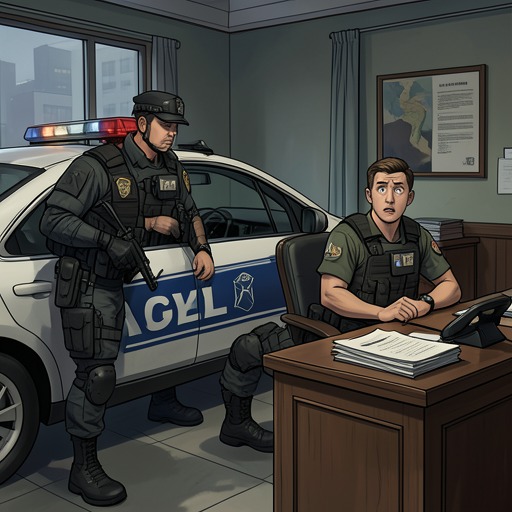
Carrie Dryer
The Minds of Billy MilliganCarrie Dryer, a pseudonym for one of the Ohio State University rape victims, is presented both as a person subjected to coercion and as a crucial witness whose careful observations helped shape the investigation. Her account identifies the assailant through details as specific as his neatly trimmed mustache and drifting eyes, while the later legal dispute over the victims’ supposed cooperation shows how sharply his internal account diverged from the circumstances she described.
Identity and Introduction
The book identifies Carrie Dryer as the first victim in the investigative sequence and explains that the name is a pseudonym. She was among the Ohio State University victims who volunteered to give a detailed account from the victim’s point of view. Her testimony is not simply a means of advancing the hunt for a suspect: it gives the investigation its human scale, grounding composite descriptions and police decisions in what one woman remembered experiencing.
Carrie described a man who wore gloves and carried a small revolver. She recalled that his eyes drifted from side to side, a movement she recognized as nystagmus. In her account, he handcuffed her to the inside door of her car, drove her to an isolated country area, and raped her. He threatened consequences if she went to the police and took names from her address book, extending the threat beyond Carrie to people she knew. These details made the danger she reported concrete: the weapon, restraint, threat, and appropriation of personal information all formed part of the same coercive encounter.
The investigation’s composite description drew on Carrie’s observations and those of Donna West. Both accounts pointed toward a white man in his twenties, of a similar height and build, with brown or reddish-brown hair and a brown jogging top, jeans, and white sneakers. One important difference remained: Carrie described a neatly trimmed mustache, while Donna described facial stubble and no mustache. The mismatch unsettled investigators, but did not erase the substantial overlap in their descriptions.
Abduction and Coerced Check-Cashing
A later narrated sequence places Carrie’s abduction on the morning of October 14. Ragen had left before dawn, carrying a Smith and Wesson and wearing a brown jogging jacket, jeans, and white running shoes. He had jogged across Columbus toward the Ohio State University campus intending to rob someone, but initially turned away from a young woman because he did not intend to rob a woman. The narration then assigns the decisive action to Adalana: as the woman leaned into her gold Toyota to collect books and papers, Adalana took the gun from Ragen’s holster and pressed it against her arm.
The woman first treated the approach as a joke, then recognized the gun and understood that the threat was real. She moved across the gearshift into the passenger seat while the assailant took her keys and got behind the wheel. He struggled briefly with the emergency brake before driving away. Carrie observed him closely: reddish-brown hair, a straight, neat mustache, a mole on his right cheek, and a well-built appearance. When they stopped at a factory parking lot, she noticed his eyes drifting from side to side, a detail that matched the observation she had already identified as significant.
The assailant searched Carrie’s purse and took identification. He handcuffed her right hand to the Toyota’s door handle and threatened her family if she contacted the police. He also referred to her planned optometry examination, a pointed detail that made the ordinary appointment part of the scene’s pressure: even that part of her day was known to him and could not simply proceed as planned. Carrie’s account of the encounter describes rape; the later sequence also follows the abduction through a forced financial transaction and release.
At a drive-in window at the Ohio National Bank branch at 770 West Broad Street, Carrie was made to cash a check while the gun remained concealed between them but pointed at her. She considered writing a plea for help on the check, but the assailant warned her not to mark it. He then instructed her to report the robbery and stop payment, shifting the intended loss to the bank. When traffic trapped the car at Broad and High streets, he told her to take over driving and repeated the threat against her and her family if she went to the police. He then left on foot and disappeared into the crowd. In this sequence, the movement from abduction to forced banking and sudden abandonment leaves Carrie to manage the immediate aftermath while the assailant vanishes into an ordinary public setting.
Identification and Investigative Value
Carrie’s observations mattered because they were both precise and subject to the limits of identification. At the lineup, she said that without the mustache she could not be sure, though the man in position number two looked familiar. Her response was not a positive identification. Polly Newton, by contrast, made a positive identification; Donna West, who had earlier identified a mug shot, was not present at the lineup. Another woman said she thought number two might be the assailant but was uncertain, while a store clerk who had cashed one of the checks selected a different man.
The sequence shows investigators weighing testimony rather than treating every resemblance as certainty. Boxerbaum was reluctant to seek an arrest warrant even after Donna West’s positive identification, in part because the photograph was three years old; he wanted the fingerprint comparison first. Carrie’s qualified lineup response likewise remained distinct from Polly Newton’s positive identification. Her role in the case rests not on a claim that she identified the accused beyond doubt, but on the detailed account she gave and the descriptive evidence she supplied.
Disputed Accounts and Narrative Significance
During a discussion of trial strategy, Arthur proposed that Ragen plead guilty to the robberies but not the rapes. Arthur invoked Adalana’s account, claiming that the three women had cooperated, had not been injured, had opportunities to leave, and had received some money back. Judy Stevenson and Gary Schweickart rejected the idea that the victims had cooperated. They understood that Arthur was describing Adalana’s perception of events, not establishing that the women had consented or that the reported threats and coercion had not occurred. Arthur said Adalana had been banished from the spot and could not be brought forward to explain her account.
Carrie’s reported experience supplies a direct counterweight to that interpretation. A gun, handcuffs, threats against family members, the control of her car and identification, and pressure to cash a check are not incidental details; together they describe the conditions under which she acted. Her careful attention to appearance and to the assailant’s unusual eye movement also turns observation into a form of testimony that survives his disappearance. The book’s treatment of Carrie therefore makes her more than an identifying witness: her account exposes the distance between a perpetrator’s rationalization and the victim’s experience of threat, constraint, and aftermath.